
Introduction
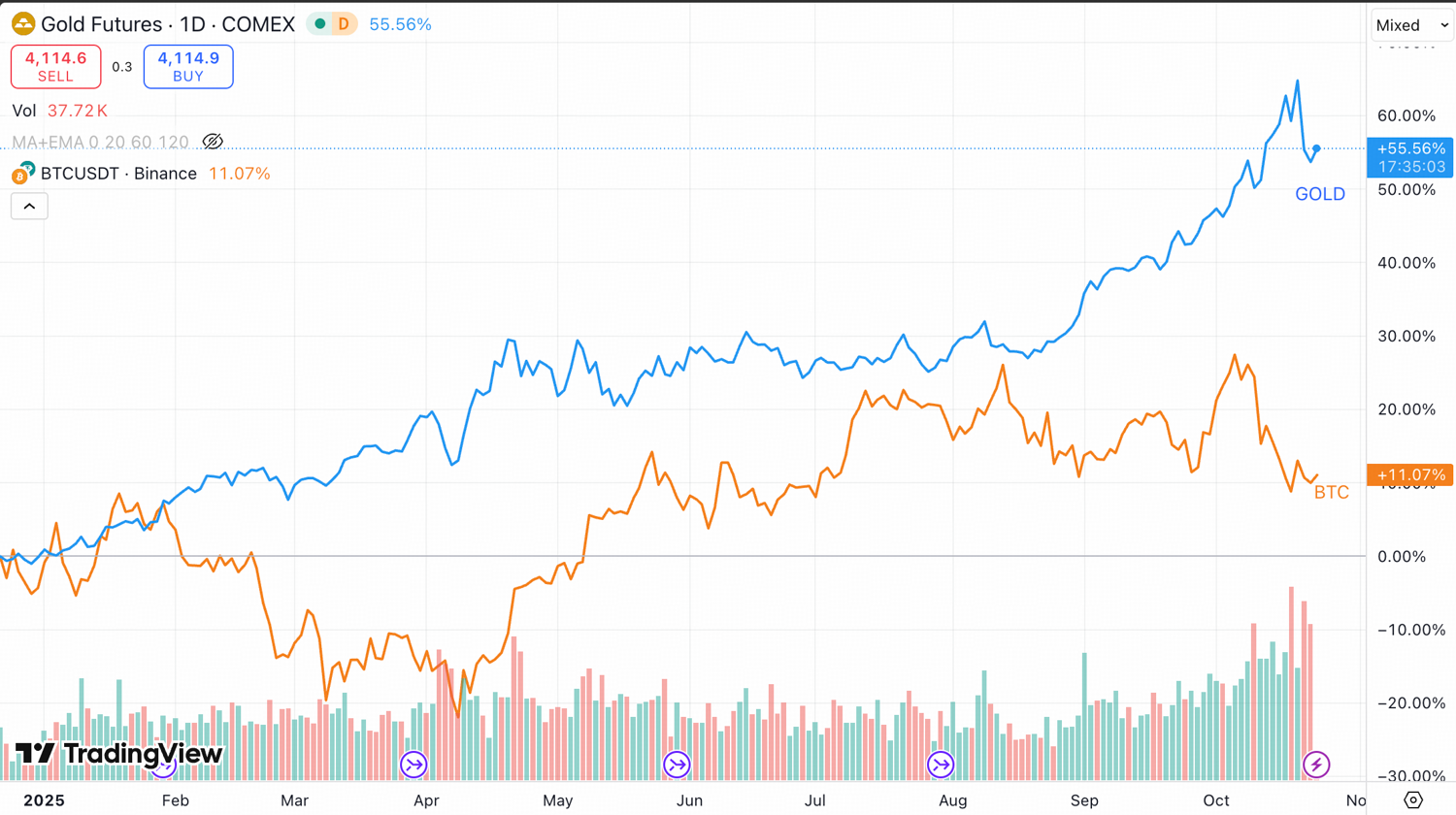
Gold has staged an extraordinary rally in 2025, repeatedly setting new all-time highs. Since the beginning of the year, the price of gold has surged more than 60%, recently breaking above $4,200 per ounce for the first time in history. Bitcoin, often described as “digital gold,” has notably failed to keep pace with this move. This growing divergence naturally raises a critical question for investors: is gold’s explosive performance a leading indicator for Bitcoin, or has Bitcoin structurally decoupled from its traditional inflation-hedge narrative? To answer this, we analyze their respective price trends, long-term correlations, and the macro forces driving demand for scarce assets.
Macro Context: The Debasement Trade
Gold’s strength is firmly rooted in its traditional role as a safe-haven asset. Persistent inflation risks, expanding fiscal deficits, geopolitical uncertainty, and declining confidence in fiat currencies have driven investors toward hard assets. This environment has given rise to what Wall Street increasingly refers to as the “debasement trade.” Unlike conventional inflation hedging, the debasement trade reflects a deeper shift in mindset. Rather than merely preserving purchasing power against rising prices, investors are questioning the integrity of fiat currencies themselves. In this framework, gold, Bitcoin, and commodities are not outperforming because inflation is high—but because fiat money is perceived as structurally weakening.
Instead of measuring returns in dollars, euros, or yuan, capital is increasingly anchored to scarce assets whose supply cannot be easily expanded. This explains why central banks have accumulated gold at a historic pace, purchasing over 1,000 tons annually in recent years as they diversify reserves away from the U.S. dollar and fiat currencies more broadly.
In theory, this backdrop should also favor Bitcoin. Like gold, Bitcoin is supply-capped, globally accessible, and independent of sovereign monetary policy. Yet despite sharing the same macro tailwinds, Bitcoin has significantly lagged gold’s recent surge.
Why Bitcoin Has Lagged Gold
There are several structural reasons for Bitcoin’s underperformance relative to gold. First, gold benefits from thousands of years of social and institutional legitimacy. It is deeply embedded in central bank reserves, sovereign balance sheets, and institutional portfolios. Bitcoin, by contrast, remains an emerging asset. Regulatory uncertainty, political sensitivities, and price volatility still limit its adoption among the most conservative pools of capital, particularly central banks.
Second, Bitcoin continues to exhibit partial “risk-on” behavior. While gold typically rallies during periods of uncertainty and falling real yields, Bitcoin has remained sensitive to liquidity conditions and equity market sentiment—especially technology stocks. As a result, Bitcoin often performs best when risk appetite is improving, rather than during periods of defensive positioning.
That said, if the current environment truly reflects a sustained debasement cycle, Bitcoin’s long-term fundamentals suggest that it should eventually reassert itself. Its fixed supply, censorship resistance, and global portability arguably make it an even purer expression of monetary scarcity than gold.
Long-Term Correlation Between Gold and Bitcoin
Looking at historical data, the relationship between gold and Bitcoin has been anything but static. Bitcoin’s correlation with gold has oscillated sharply over time, ranging from deeply negative to strongly positive.
In late 2021, the 180-day correlation between BTC and gold fell to around –0.8, indicating near-opposite behavior. By late 2023, that correlation had surged to +0.9—an all-time high—before moderating and then strengthening again in 2025, currently hovering above +0.85.
This renewed correlation suggests that Bitcoin may be gradually transitioning into a more gold-like role within this cycle. Increasingly, institutional investors appear to be allocating to Bitcoin not purely as a speculative asset, but as part of a broader macro hedge alongside gold.
Short-Term Divergence, Long-Term Echo
Despite the strengthening long-term correlation, recent price action tells a different story. Since late August, gold has continued its relentless climb, while Bitcoin has remained stuck in consolidation.
On the surface, the two assets appear disconnected. However, research from Bitcoin Magazine highlights a critical insight: when a lag of roughly 10 weeks is applied, the correlation between gold and Bitcoin exceeds 90%. In other words, Bitcoin often mirrors gold’s moves—but with a delay.
This lag can be explained by market structure. Gold’s deep, institutionally dominated market allows it to price in macro changes rapidly and efficiently. Bitcoin’s smaller, more retail-driven ecosystem introduces volatility and friction, causing macro alignment to emerge later in the cycle.
Gold typically moves first as institutional capital reacts to shifts in real rates and monetary conditions. Bitcoin follows once liquidity effects spread and capital begins rotating toward higher-beta expressions of the same macro thesis.
The Role of Recent Crypto Liquidations
Bitcoin’s recent stagnation is also tied to a significant internal shock. Around October 10–11, the crypto market experienced a $19 billion liquidation cascade—one of the largest deleveraging events of the year. Excess leverage was aggressively flushed from derivatives markets, severely damaging trader confidence.
Since that event, Bitcoin’s open interest has struggled to recover, reflecting ongoing caution among leveraged participants and a lack of speculative rebuilding.
Gold, by contrast, has seen steadily rising open interest, supported by persistent optimism and institutional positioning. This divergence may itself be setting the stage for a reversal.
Excessive leverage in gold markets increases the risk of a near-term correction, as crowded positioning often precedes local tops. If gold enters a consolidation phase, capital is likely to rotate elsewhere.
Bitcoin, having already undergone a painful deleveraging, may be better positioned for the next leg higher. With speculative excess largely cleared, Bitcoin’s market structure appears healthier—potentially allowing it to “catch up” once gold’s momentum cools.
Closing Thoughts
Gold’s historic rally reflects a deepening global shift toward hard assets and away from fiat-based systems. Bitcoin, while lagging in the short term, remains fundamentally aligned with the same debasement-driven narrative.
If history rhymes, gold may continue to lead—but Bitcoin may not be far behind.
Disclaimer: The information provided herein does not constitute investment advice, financial advice, trading advice, or any other sort of advice, and should not be treated as such. All content set out below is for informational purposes only.